







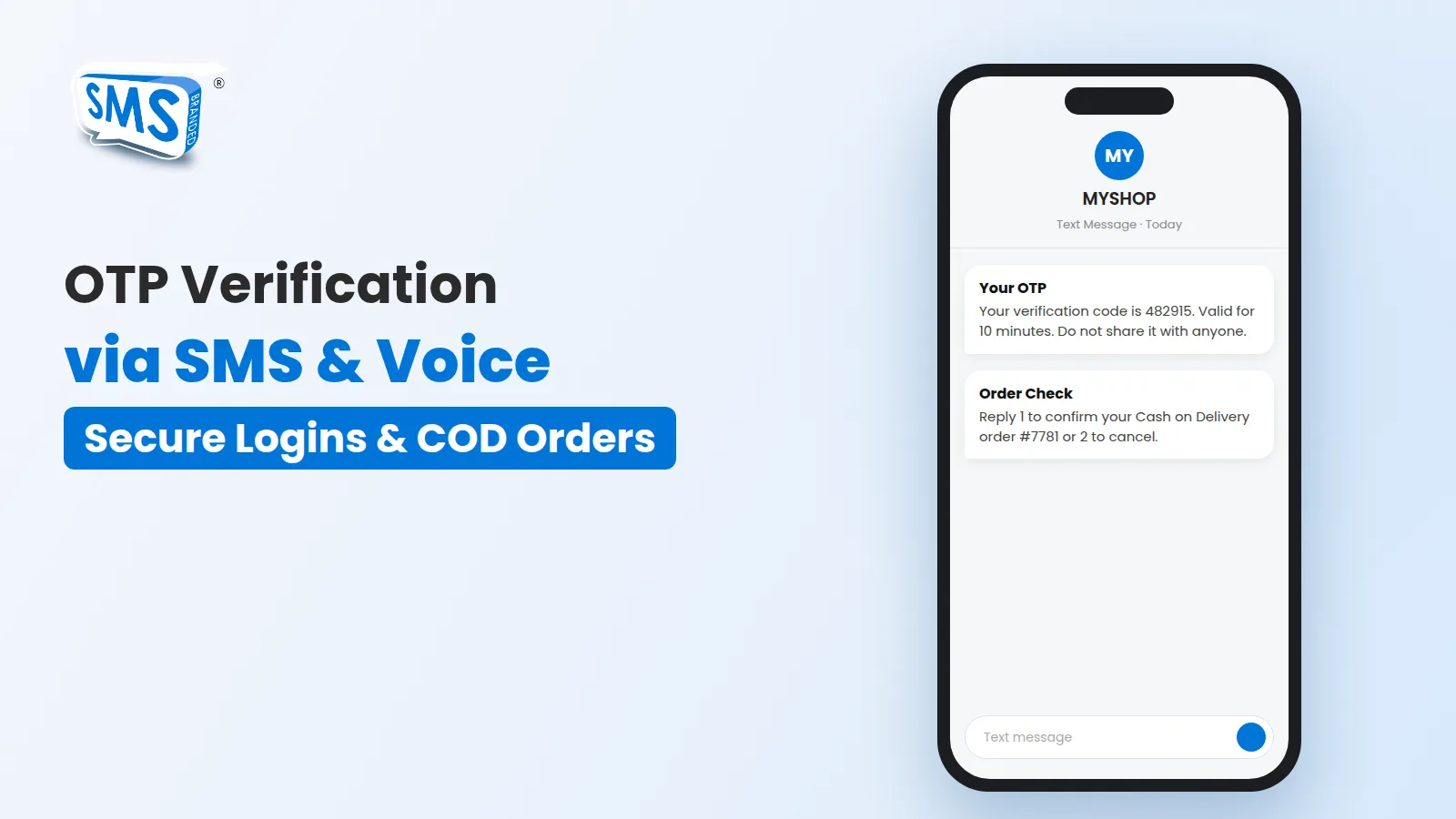

Fake signups, stolen accounts and fake Cash on Delivery orders cost Pakistani businesses time and money every day. One of the simplest ways to stop them is a one-time password (OTP): a short code sent to the customer’s phone that proves the number is real and belongs to them.
This guide explains how OTP verification works, where to use it and how to deliver OTPs reliably through SMS and voice calls.
What is OTP verification?
An OTP is a temporary code, usually 4 to 6 digits, that is valid for one use and a short time. Your website or app generates the code, sends it to the customer’s mobile number, and asks the customer to enter it. If the code matches, the action is verified.
Where businesses in Pakistan use OTP
- Account signup: confirm that a new user owns the mobile number they entered.
- Login and two-step verification: add a second layer of security to customer and staff accounts.
- Cash on Delivery order confirmation: verify the number before dispatching a parcel, which reduces fake orders and returns.
- Password reset: let customers recover their account safely.
- Payments and sensitive changes: confirm transactions or changes to account details.
How OTP verification works with Branded SMS Pakistan
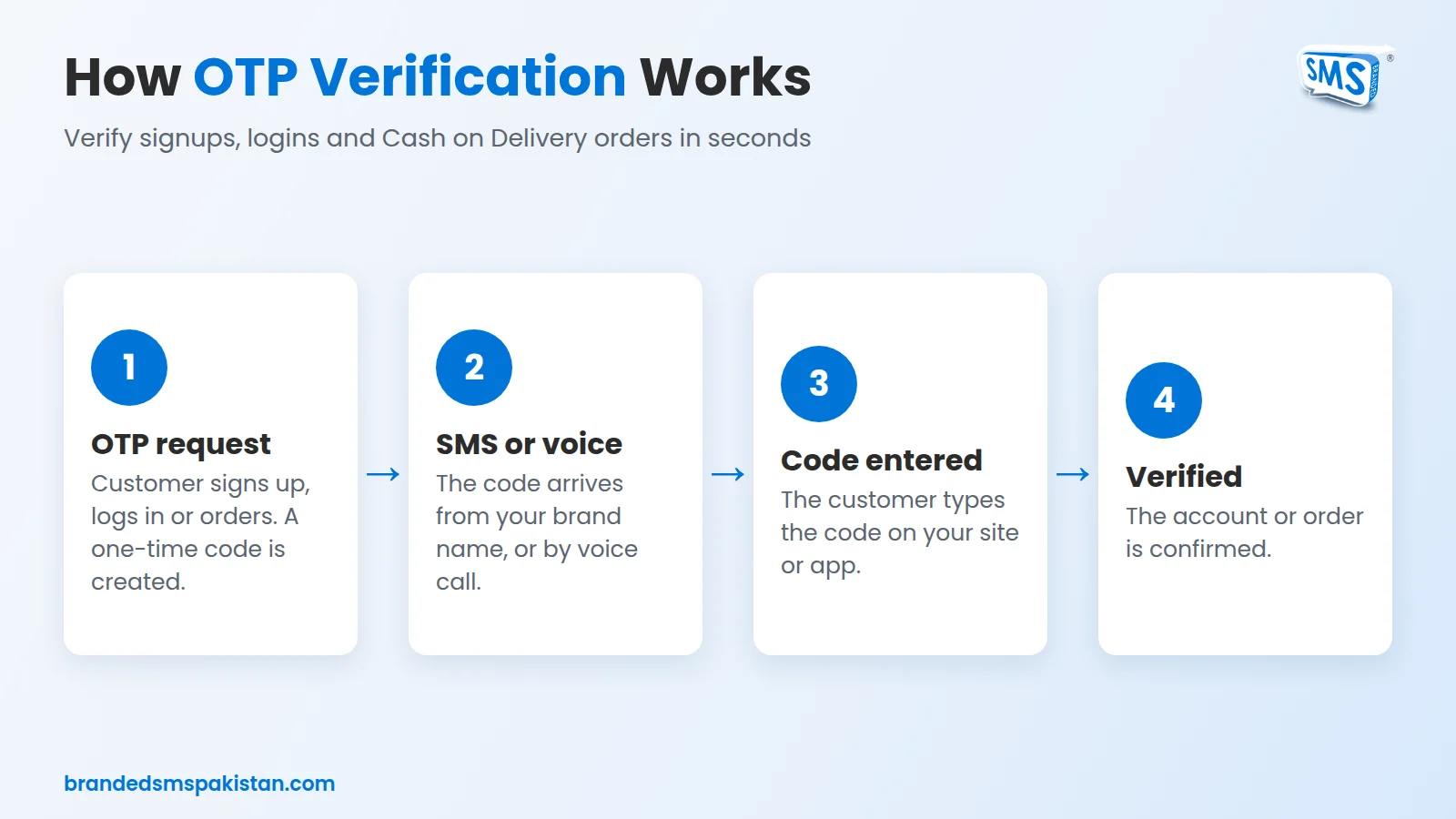
- OTP request: your system generates a one-time password when a customer signs up, logs in or places an order.
- OTP delivery: Branded SMS Pakistan delivers the code by SMS under your registered sender ID, or by an automated voice call.
- Customer verification: the customer enters the code and your system confirms the action.
You can read more about the service on our OTP verification page.
SMS OTP vs voice OTP
SMS OTP
SMS is the most common way to deliver OTPs. It is fast, works on every mobile phone and does not need an internet connection. With a registered sender ID, the OTP arrives from your brand name, so customers know it is genuine.
Voice OTP
With a voice OTP, an automated call reads the code out to the customer. It is useful as a backup when an SMS is delayed, when a customer cannot read the message, or for customers who prefer calls. Our automated voice call service also supports order confirmation calls in English and Urdu.
Using OTP to reduce fake COD orders
Cash on Delivery is still the most popular payment method in Pakistani e-commerce, and it is also where fake orders hurt the most. Every fake order means wasted packaging, courier charges and return costs. Adding a verification step before dispatch helps you ship only to real, reachable customers.
Our e-commerce tools make this easy:
- The order verification feature asks customers to confirm their order by SMS.
- IVR verification calls let customers confirm or cancel with a key press.
- The Shopify SMS app and WooCommerce plugin connect these features to your store without coding.
Best practices for OTP messages
- Keep it short: put the code first, for example “Your verification code is 482915.”
- Set an expiry: make codes valid for a few minutes only, and say so in the message.
- Add a safety line: “Do not share this code with anyone” helps protect customers from fraud.
- Use your brand name: send OTPs from a registered sender ID or a short code so customers trust them.
- Limit retries: allow a small number of resend attempts to prevent abuse.
- Offer a fallback: if the SMS does not arrive, offer a voice call.
How to integrate OTP into your website or app
Developers can connect OTP delivery through our SMS and OTP API, which works with any programming language. If you use a platform such as Shopify, WooCommerce or WHMCS, you can start with our ready-made integrations and plugins instead. For special requirements, we also build custom integrations.
Start verifying customers today
OTP verification protects your customers, reduces fraud and saves your team from manual checks. Contact our team to set up SMS and voice OTP for your business.